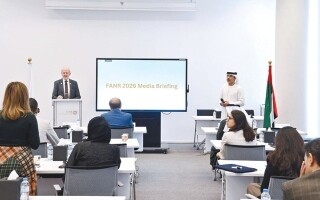
In 2025, the Federal Authority for Nuclear Regulation conducted 36 inspections on the Barakah Nuclear Power Plant project, equivalent to approximately 1,300 working days. These inspections covered areas of nuclear safety, nuclear security, radiation protection, and nuclear non-proliferation. During a press briefing in Abu Dhabi yesterday, the Authority's Director-General, Christer Viktorsson, confirmed the Authority's commitment to building Emirati capabilities and enhancing the skills of inspectors through a qualification program that includes training, on-the-job mentoring, and professional development activities. He noted that more than 90 inspectors have been qualified to date and that the Authority currently has 245 employees, 79% of whom are Emirati citizens, with 73% of citizens working in technical positions. In line with licensing requirements, the Authority approved over 40 reactor operators and senior operators in 2025, bringing the total number of qualified personnel at Barakah to 300, which enhances the assurance of safe nuclear facility operation. As the first unit of the Barakah plant enters its fifth year of operation, the Authority is currently working to approve the periodic safety review submitted by Nawah Energy. This review includes the station's design, waste management, safety culture, and other critical factors to ensure the safe and continued operation of the plant. The Authority also oversaw fuel loading and maintenance activities across the four units. The Authority launched the UAE Nuclear and Radiation Academy Ambassadors program at the University of Sharjah to raise awareness of nuclear sciences among university students. The academy was launched in 2024 to build sustainable national expertise in the nuclear and radiation sector, and currently has over 740 students enrolled in various educational and training programs. According to the media briefing, the Authority conducted 48 inspection-related activities and 98 import and export control inspections last year to ensure licensees' compliance with regulatory requirements. The state has fully met the requirements of the nuclear non-proliferation treaties signed with the International Atomic Energy Agency (IAEA), including the Comprehensive Safeguards Agreement and the Additional Protocol. The IAEA confirmed that the UAE received a 'Full Transparency' classification for the third consecutive year in 2025, the highest level of safeguards the Agency offers, confirming that the UAE's nuclear program is entirely peaceful and fully complies with international commitments. The Authority strengthened its efforts to protect nuclear materials and facilities in the country. In 2025, it conducted 59 nuclear security inspections on facilities using radioactive materials and 322 inspections on vehicles transporting radioactive sources. The Authority reported that it issued a total of 1,770 licenses for medical and non-medical facilities and over 1,600 import and export licenses for radioactive sources in 2025. It also conducted 227 inspections on facilities using radioactive sources, while the Authority's Secondary Standard Dosimetry Laboratory performed approximately 1,600 calibrations for various entities in the country, supporting safe and efficient operation. The Authority confirmed its continued development of national capacity in the radiation sector, announcing the graduation of the first cohort of the National Program for Qualifying Personnel for Nuclear and Radiation Emergencies. This program was launched in 2024 in collaboration with the Ministry of Interior and aims to train 3,000 workers in emergency response. As part of enhancing the emergency preparedness and response system, the Authority participated in 15 national and international exercises, including scenarios for transboundary nuclear emergencies, and delivered 10 specialized training courses on nuclear emergencies to over 60 participants. In line with the government's 'Zero Bureaucracy' program, the Authority confirmed its efforts to improve services for over 4,000 licensees by simplifying and enhancing the efficiency and effectiveness of procedures. It revealed that it had restructured five core licensing services, resulting in a reduction of transaction processing time by over 50%. It is worth noting that the Barakah plant is currently the largest source of electricity in the UAE, providing approximately 25% of the country's energy needs. With the full commercial operation of the four units, the UAE has become a successful model for new countries in the field of nuclear energy, many of which have expressed interest in leveraging the Authority's regulatory experience.